I try to take one major camping trip a year. This year I settled on Tennessee to visit the Great Smoky Mountains. Everything I had heard and read said I was in for some amazing views. The other motivation was I had 8 states left to visit in the US and North/South Carolina happened to two of them. This trip I’d be able to stay in NC and drive down to SC to knock that state off my list.
After spending some time researching the best hikes (shout out to http://www.hikinginthesmokys.com/), I settled on the Cades Cove area as my “base” for the trip. When you’re backpacking (or camping in general) in a national park it’s important to select a region ahead of time. Look at topo maps, talk to park rangers, visit the park’s website, etc all to inform your decision. What you’re looking for are dangers. Is there increased bear activity or a potential for flooding? Knowing these little things in advance will go a long way to make your life easier out on a trail. For me, the major concerns of the Smoky Mountains centered around bears. The website and park rangers warned about increased bear sightings. Specifically black bears – the ones that love to climb a tree to eat your food. Grizzly Bears are the more frightening of the two major bear species of the US, but they mainly hang out in the west (think Yellowstone). Grizzlies can grow up to 800 lbs on the high end of the scale – all from 1 lb at birth – and really don’t like humans roaming around their kids. Black bears on the other hand max out at a cuddly 500 lbs. All bears (and wildlife generally) will defend their cubs if they think you’re a threat. You think you love your child? Get between a momma bear and her cubs and you’ll discover just how little your love seems compared to theirs. But I’ll come back to bears later.
So my plan to attack the Great Smoky Mountains was simple. Camp in an established site for the first two nights, then set out onto the Appalachian Trail and camp for a night or two out of my backpack. I had the locations all selected already – you can no longer just camp wherever you want in the Smoky’s. Instead you have to register in advance on their website to get a permit (the backcountry permits cost $4 per night for one person). Permit in hand, I headed out for the 10 hour drive to Tennessee. So if I was going to hike the AT and camp along it, why stay at an established campsite? Good question, first it was because I wouldn’t arrive in Tennessee until late (6pm). I could have prepped my pack ahead of time, jumped out of the car and headed right onto the trail, but darkness always come faster than you realize in a forest and I had never hiked this area before. I know nothing about the terrain except for what some websites say and my maps show. There were some pretty serious elevation changes. I probably would have been fine, but I decided to play it safe. Second, it would allow me to set up my tent, get my stove working, fill up on water, and all the other things you want to check before setting out on an overnight hike. It is unbelievably important to check your gear before you go out in backcountry. The tent you dried out and packed properly when you put it away from the last trip could suddenly have a hole in it. Your camp stove which provided you all your meals and worked perfectly last month, may not light this time. Remember when you put away your camel pack? Did it get snagged on something and now leaks? Check all your gear, then check it again. Since I was leaving straight from work, I was going to use these two nights of camping next to my car as my testing ground.
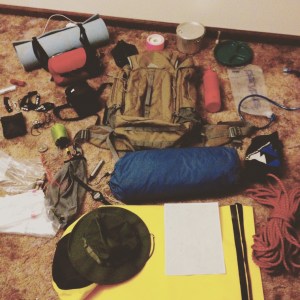 The night before I was leaving I put together my pack with clothes, tent, sleeping bag, ground pad, water, food, stove, fuel, knife, map, compass, flashlight, shovel, toilet paper, ziplock bags, a food bag, rope, and a few other items. The food and ziplock bags were important because bears love to eat your food. If you leave your food in your tent, the bears love to eat you too (kinda accidentally). So the trick it to toss your rope over a tree limp, tie it to your food back holding anything that has an odor, and pull the bag up high enough so you cant reach it (generally at least 10 feet). You can either tie the rope off to the base of the tree or attach a counter weight. The recommendation from just about every expert is to use a counter weight because bears will sometimes cut the rope tied around the tree. That’s right, bears have figured out how to get at the airtight food bag hanging 10 feet above them. And you’re going to spend the night in the woods with them. (side note, make sure you dont set up your tent right next to the food bag…).
With the gear all packed up, my plan was to arise bright and early the next morning to drive 10 hours to the Great Smoky Mountains.

 Bivy Life